Compile-time context detection, compiler abstractions, math utilities, and intrusive data structure macros. More...
#include <stddef.h>#include <stdint.h>#include <stdio.h>#include <string.h>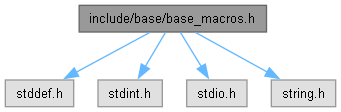
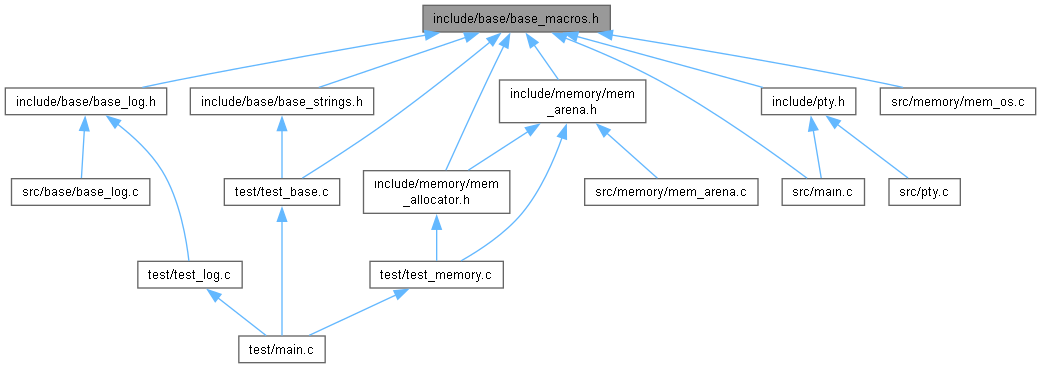
Go to the source code of this file.
Macros | |
| #define | WIN32_LEAN_AND_MEAN |
| Excludes rarely-used services from Windows headers to speed up compilation. | |
| #define | OS_WINDOWS 1 |
| Defined to 1 if compiling for a Windows operating system. | |
| #define | OS_NAME "Windows" |
| Human-readable string name of the operating system. | |
| #define | BUILD_DEBUG 1 |
| Defined to 1 if compiling in Debug mode. | |
| #define | BUILD_NAME "Debug" |
| Human-readable string name of the build configuration. | |
| #define | C_STANDARD 89 |
| Integer representing the detected C standard version. | |
| #define | C_STANDARD_NAME "C89/Default" |
| Human-readable string of the detected C standard. | |
| #define | INTERNAL static |
| Marks a function or variable as strictly internal to its translation unit (static). | |
| #define | EXTERNAL extern |
| Marks a function or variable as externally linked (extern). | |
| #define | API_EXPORT |
| Exports a symbol from a shared library (.dll / .so). | |
| #define | API_LOCAL |
| Hides a symbol from a shared library (.dll / .so). | |
| #define | C_LINKAGE_BEGIN |
| Opens a C linkage block for C++ compilers (Empty in C). | |
| #define | C_LINKAGE_END |
| Closes a C linkage block for C++ compilers (Empty in C). | |
| #define | STRINGIFY_DETAIL(x) |
| Internal implementation of STRINGIFY. Do not use directly. | |
| #define | STRINGIFY(x) |
| Safely converts a macro argument into a string literal. | |
| #define | GLUE_DETAIL(x, y) |
| Internal implementation of GLUE. Do not use directly. | |
| #define | GLUE(x, y) |
| Safely concatenates two tokens together into a single token. | |
| #define | INT_FROM_PTR(ptr) |
| Safely casts a pointer to an integer of pointer size. | |
| #define | PTR_FROM_INT(type, val) |
| Safely casts a pointer-sized integer back to a specific pointer type. | |
| #define | ARRAY_SIZE(arr) |
| Calculates the number of elements in a statically allocated array. | |
| #define | MIN(a, b) |
| Returns the minimum of two values (Standard C fallback). | |
| #define | MAX(a, b) |
| Returns the maximum of two values (Standard C fallback). | |
| #define | CLAMP(val, min, max) |
| Clamps a value between a minimum and a maximum (Standard C fallback). | |
| #define | SWAP(type, a, b) |
| Generic variable swap. | |
| #define | ALIGN_UP_POW2(x, p) |
| Aligns a value UP to the nearest power of 2. | |
| #define | ALIGN_DOWN_POW2(x, p) |
| Aligns a value DOWN to the nearest power of 2. | |
| #define | IS_POW2_OR_ZERO(x) |
| Checks if a given integer is a power of 2 (or zero). | |
| #define | MEM_ZERO(ptr, size) |
| Wraps memset to explicitly write 0s to a block of memory. | |
| #define | MEM_ZERO_STRUCT(ptr) |
| Zeroes out a struct securely using the pointer's inner type size. | |
| #define | MEM_ZERO_ARRAY(arr) |
| Zeroes out a static array securely using the array's full size. | |
| #define | MEM_COPY(dst, src, size) |
| Wraps memmove for standard memory copying. | |
| #define | MEM_COPY_STRUCT(dst, src) |
| Safely copies data from one struct pointer to another. | |
| #define | MEM_COPY_ARRAY(dst, src) |
| Safely copies data from one static array to another. | |
| #define | DLL_PUSH_BACK_NP(f, l, n, next, prev) |
| Pushes a node to the back of a doubly linked list (Custom pointer names). | |
| #define | DLL_PUSH_BACK(f, l, n) |
| Pushes a node to the back of a doubly linked list. | |
| #define | DLL_PUSH_FRONT(f, l, n) |
| Pushes a node to the front of a doubly linked list. | |
| #define | DLL_REMOVE_NP(f, l, n, next, prev) |
| Removes a node from a doubly linked list (Custom pointer names). | |
| #define | DLL_REMOVE(f, l, n) |
| Removes a node from a doubly linked list. | |
| #define | SLL_QUEUE_PUSH_N(f, l, n, next) |
| Pushes a node to a singly linked queue (Custom pointer name). | |
| #define | SLL_QUEUE_PUSH(f, l, n) |
| Pushes a node to the back of a singly linked queue. | |
| #define | SLL_STACK_PUSH_N(f, n, next) |
| Pushes a node to the top of a singly linked stack (Custom pointer name). | |
| #define | SLL_STACK_PUSH(f, n) |
| Pushes a node to the top of a singly linked stack. | |
| #define | SLL_STACK_POP_N(f, next) |
| Pops a node from the top of a singly linked stack (Custom pointer name). | |
| #define | SLL_STACK_POP(f) |
| Pops a node from the top of a singly linked stack. | |
| #define | debug_break() |
| Triggers a native breakpoint in GDB/LLDB. | |
| #define | ASSERT(expr) |
| Standard runtime assertion. Triggers a debug break on failure. | |
| #define | ASSERT_NOT_NULL(ptr) |
| Asserts that a given pointer is not NULL. | |
Functions | |
| static void | print_context_info (void) |
| Prints OS, architecture, compiler, endianness, build, and C standard to stdout. | |
Detailed Description
Compile-time context detection, compiler abstractions, math utilities, and intrusive data structure macros.
This is the lowest-level header in the base layer. It detects the current OS, compiler, architecture, endianness, C standard, and build configuration at compile time via preprocessor macros, then exposes a set of zero-cost utility macros built on top of that context.
Include order: this header has no dependencies within ccDB and may be included first by any other header.
- Copyright
- 2025 Alfred Jijo (MIT License)
Definition in file base_macros.h.
Macro Definition Documentation
◆ WIN32_LEAN_AND_MEAN
| #define WIN32_LEAN_AND_MEAN |
Excludes rarely-used services from Windows headers to speed up compilation.
Definition at line 23 of file base_macros.h.